
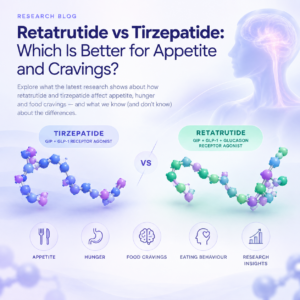
When people compare retatrutide and tirzepatide, the discussion usually focuses on weight reduction.
But there is another interesting question emerging from clinical research:
What happens to appetite, hunger and food cravings?
This is particularly interesting because both peptides act on pathways involved in metabolic signalling, but they do so in different ways.
Tirzepatide activates the GIP and GLP-1 receptors, while retatrutide activates GIP, GLP-1 and glucagon receptors.
That additional receptor activity has led to considerable interest in whether retatrutide might produce different effects on appetite and eating behaviour.
So, is retatrutide actually better than tirzepatide for controlling appetite and cravings?
The research is beginning to give us some clues — but there is an important limitation.
There is currently no direct head-to-head clinical trial showing that retatrutide is superior to tirzepatide specifically for appetite or food cravings.
Instead, we have separate studies examining each compound.
Why Do Appetite and Food Cravings Matter?
Weight change is not simply about how much energy the body uses.
Eating behaviour is influenced by several interacting signals, including:
- Hunger
- Fullness and satiety
- Food reward
- Food cravings
- Appetite
- Meal size
- How frequently someone feels the urge to eat
- Responses to food-related cues
This is one reason researchers are increasingly interested in measuring eating behaviour alongside body weight.
A compound may influence weight through several biological mechanisms, and reducing appetite or food intake can be one part of that picture.
How Does Tirzepatide Affect Appetite?
Tirzepatide is a dual receptor agonist that activates both GIP and GLP-1 receptors.
A 2025 Phase 1 study specifically investigated how tirzepatide affected eating behaviour in adults with overweight or obesity.
The study included 114 adults without diabetes and looked at energy intake, appetite, food cravings and other measures of ingestive behaviour.
The researchers found that, compared with placebo, tirzepatide reduced:
- Overall appetite
- Food cravings
- Perceived hunger
- Tendency to overeat
- Reactivity to food-related environmental cues
The study also found a significant reduction in energy intake during an ad-libitum meal.
This is important because it provides human experimental evidence that the effects of tirzepatide are not limited to changes seen on the scales.
Researchers were able to measure changes in eating behaviour relatively early in the study.
What About Food Cravings Specifically?
A separate analysis from the same Phase 1 programme looked more closely at participant-reported food cravings and food preferences.
This research provides additional evidence that tirzepatide can influence how participants report their relationship with food, although these findings should still be interpreted within the limitations of a relatively short Phase 1 study.
In other words, there is now specific clinical research looking at cravings and eating behaviour, rather than simply assuming that reduced body weight means reduced appetite.
What Does Retatrutide Do to Appetite?
Retatrutide is different from tirzepatide because it activates three receptor pathways:
GIP + GLP-1 + glucagon
It is therefore often described as a triple agonist.
Retatrutide remains an investigational compound and has not been approved by regulatory agencies for public use. Lilly is continuing to evaluate it in Phase 3 clinical trials.
However, researchers have already started investigating its effects on eating behaviour.
And this is where the comparison with tirzepatide becomes particularly interesting.
Retatrutide Research Has Looked Directly at Hunger and Eating Behaviour
A Phase 2 analysis published in Diabetes, Obesity and Metabolism examined appetite and eating behaviour in 275 adults with type 2 diabetes.
Participants received placebo, dulaglutide or different retatrutide treatment groups.
The researchers assessed several measures, including:
- Overall appetite
- Hunger
- Prospective food consumption
- Perceived hunger
- Disinhibition, which broadly reflects the tendency to overeat
- Dietary restraint
Compared with placebo, participants receiving retatrutide at 4 mg or higher reported greater reductions in overall appetite, hunger and prospective food consumption at Week 24.
Higher retatrutide groups also showed improvements in perceived hunger and disinhibition.
Interestingly, changes in perceived hunger and disinhibition were statistically associated with changes in body weight.
That gives researchers another piece of the puzzle.
Rather than simply observing that participants lost weight, the study looked at whether changes in eating behaviour accompanied that weight reduction.
Retatrutide vs Tirzepatide: What Can We Actually Say?
This is where things become more complicated.
It is tempting to look at the two studies and conclude:
Retatrutide reduces appetite more than tirzepatide.
But the available evidence does not allow us to make that conclusion.
The studies were different.
| Tirzepatide | Retatrutide | |
|---|---|---|
| Main receptor activity | GIP + GLP-1 | GIP + GLP-1 + glucagon |
| Appetite research | Yes | Yes |
| Food-craving research | Yes | Eating-behaviour research |
| Direct head-to-head appetite trial | No | No |
| Human clinical research | Extensive | Rapidly expanding |
| Development status | Established clinical medicine | Investigational |
The tirzepatide appetite study was a short Phase 1 study in adults with overweight or obesity.
The retatrutide appetite analysis was a Phase 2 study in adults with type 2 diabetes and examined several measures over a longer period.
Because the populations, study designs, endpoints and treatment protocols were different, the results cannot simply be placed side-by-side and treated as a direct comparison.
Why Retatrutide Is Still Interesting
Even though we cannot currently say that retatrutide is better for cravings, its mechanism has created a major area of research interest.
Tirzepatide
GIP → GLP-1
Two receptor pathways are activated by the same molecule.
Retatrutide
GIP → GLP-1 → Glucagon
Retatrutide adds glucagon receptor activity to the GIP and GLP-1 pathways.
This means researchers are investigating whether the additional pathway produces a different overall metabolic response.
It is one of the reasons retatrutide has become such an important compound in current metabolic research.
Could the Glucagon Pathway Affect Appetite?
This is an area where it is important not to overstate the evidence.
Glucagon has biological effects that are relevant to energy metabolism, but the precise contribution of glucagon receptor activation to human appetite and food intake with retatrutide is still being investigated.
The fact that retatrutide affects three receptor systems does not automatically mean that every effect will be three times stronger.
Biology is considerably more complicated than simply counting receptor targets.
The interaction between these pathways may be more important than any individual receptor considered in isolation.
What About Overall Weight Reduction?
This is where the available evidence currently gives us a much larger body of data.
The Phase 2 retatrutide obesity trial involved 338 adults and reported substantial dose-dependent reductions in body weight over 48 weeks.
At 48 weeks, the reported mean changes ranged from −8.7% with 1 mg to −24.2% with 12 mg, compared with −2.1% with placebo.
More recently, Phase 3 TRIUMPH studies have produced further results.
For example, Lilly reported that in TRIUMPH-1, participants receiving the 12 mg retatrutide treatment group had an average weight reduction of 28.3% at 80 weeks.
However, these results should not be interpreted as evidence that retatrutide is automatically “better” than tirzepatide.
Why?
Because those studies were not designed as direct retatrutide-versus-tirzepatide comparisons.
Different trials have different participants, designs, treatment periods and statistical methods.
Does More Weight Loss Mean Better Appetite Control?
Not necessarily.
This is an important distinction.
Weight reduction and appetite reduction are related, but they are not identical measurements.
A person’s body weight can be influenced by:
- Food intake
- Energy expenditure
- Gastric and gastrointestinal effects
- Hormonal signalling
- Changes in fat mass
- Changes in lean mass
- Metabolic adaptation
- Duration of treatment
- Individual biological differences
This is why researchers measure appetite and eating behaviour separately.
The retatrutide appetite analysis found that reductions in perceived hunger and disinhibition were associated with weight reduction, but an association does not prove that one factor alone caused the other.
Similarly, the tirzepatide Phase 1 research suggests that changes in ingestive behaviour may contribute to reduced energy intake, but it does not establish a single mechanism responsible for all subsequent weight changes.
What About “Food Noise”?
The phrase “food noise” has become increasingly common when people discuss appetite-modifying medicines.
It generally refers to persistent thoughts, urges or preoccupation surrounding food.
Researchers do not always measure “food noise” directly.
Instead, clinical studies may use validated measures of:
- Hunger
- Appetite
- Food cravings
- Food reward
- Eating disinhibition
- Dietary restraint
- Food-related cue responsiveness
This distinction matters because everyday language and scientific measurement are not always the same thing.
The recent tirzepatide research is particularly interesting because it included measures of food cravings and responses to food-related cues.
Retatrutide research has also begun examining related eating behaviours, including perceived hunger and disinhibition.
So Which One Is Better for Appetite and Cravings?
The research does not currently provide a definitive answer.
Tirzepatide has direct human evidence showing reductions in appetite, food cravings, perceived hunger and overeating behaviour compared with placebo in a controlled Phase 1 study.
Retatrutide has separate Phase 2 evidence showing reductions in appetite, hunger and prospective food consumption, with additional improvements in perceived hunger and disinhibition at higher studied treatment groups.
Both findings are scientifically interesting.
But because the studies were conducted separately, with different populations and designs, they should not be interpreted as proof that one compound suppresses appetite more strongly than the other.
A properly designed head-to-head clinical trial using the same participants, treatment duration and validated appetite and craving measurements would provide much stronger evidence.
That is the comparison researchers would ultimately need to make a confident statement about relative effects.
Why This Area of Research Matters
The next generation of metabolic research is increasingly looking beyond a simple question of:
“How much weight did participants lose?”
Researchers are also asking:
“Why did they eat less?”
“Did hunger change?”
“Did food cravings change?”
“Did participants feel fuller?”
“Did their response to food cues change?”
“How did these changes relate to body-weight reduction?”
Retatrutide and tirzepatide provide particularly interesting examples because they target overlapping but different receptor combinations.
As more Phase 3 data and dedicated eating-behaviour studies become available, researchers may be able to understand these differences in much greater detail.
Explore More Retatrutide Research
If you want to understand the science behind retatrutide in more detail, our Retatrutide Research Guide covers its receptor activity, clinical research and the development of the compound.
You can also explore:
Peptide Receptor & Mechanism Research
Understand how GLP-1, GIP and glucagon receptor pathways are being investigated.
Clinical Trial Research
Learn how Phase 1, Phase 2 and Phase 3 peptide studies are designed and interpreted.
Peptide Tolerance & Weight-Loss Plateaus
Explore what research suggests about appetite, metabolic signalling and changes in weight over longer periods.
Frequently Asked Questions
Is retatrutide stronger than tirzepatide for appetite suppression?
There is currently no direct clinical evidence establishing that retatrutide is superior to tirzepatide specifically for appetite suppression. Separate studies have reported reductions in appetite and hunger with both compounds, but the studies used different populations and methodologies.
Does retatrutide reduce food cravings?
Retatrutide research has reported reductions in measures including perceived hunger and disinhibition, as well as overall appetite and prospective food consumption. However, these findings should not be interpreted as proof that retatrutide eliminates or universally reduces food cravings.
Has retatrutide been directly compared with tirzepatide?
Not in a clinical trial specifically designed to compare their effects on appetite and food cravings. Most current comparisons rely on separate clinical studies, which have important methodological differences.
Why is retatrutide different from tirzepatide?
Tirzepatide activates GIP and GLP-1 receptors, whereas retatrutide activates GIP, GLP-1 and glucagon receptors. Retatrutide is therefore described as a triple receptor agonist.
Is retatrutide approved?
No. Retatrutide remains an investigational compound and is currently being evaluated in Phase 3 clinical research. Lilly states that it has not been approved by a regulatory agency.
Does reduced appetite explain all of the weight loss?
No. Appetite and food intake are important parts of the picture, but weight change involves multiple biological processes. Clinical research therefore measures several outcomes rather than treating appetite alone as an explanation for weight reduction.
Research Use Only
The information on this page is provided for scientific and educational reference only. It summarises published and reported research and is not medical advice or a recommendation for personal use.
Retatrutide is an investigational compound and is not approved for human use.
TrimFast research materials are supplied for laboratory and scientific research purposes only and are not intended for human or veterinary use.