
If you’ve been researching weight loss peptides or GLP-1 medications, you’ve likely come across three names: semaglutide, tirzepatide, and retatrutide.
These compounds are part of a new wave of incretin-based therapies that are changing how weight management and metabolic health are approached in clinical settings.
But while they’re often grouped together, they work differently—and their results can vary significantly.
What Are GLP-1 and Incretin-Based Therapies?
GLP-1 (glucagon-like peptide-1) is a hormone involved in:
- Appetite regulation
- Blood sugar control
- Slowing digestion
- Energy balance
Modern peptide therapies are designed to mimic or enhance these natural processes.
👉 Related: Explore Semaglutide
👉 Related: Explore Tirzepatide
Semaglutide: The Foundation of Modern GLP-1 Weight Loss
Semaglutide is one of the most widely used GLP-1-based therapies.
How semaglutide works
It mimics the GLP-1 hormone, leading to:
- Reduced appetite
- Slower gastric emptying
- Improved blood glucose regulation
Clinical performance
Studies have shown:
- Around 10–15% average weight loss
- Consistent appetite reduction over time
Additional benefits
- Improved metabolic markers
- Cardiovascular risk reduction in certain populations
Summary
Semaglutide is often considered:
- Well-established
- Predictable
- A strong starting point in GLP-1 therapy
Tirzepatide: Dual-Hormone Metabolic Enhancement
Tirzepatide builds on GLP-1 by targeting an additional pathway.
How tirzepatide works
It activates:
- GLP-1 receptors
- GIP receptors (enhancing insulin sensitivity and metabolic response)
Clinical performance
Trials have reported:
- 15–22% weight loss depending on dose
- Strong improvements in insulin regulation
Additional benefits
- Greater appetite suppression for many individuals
- Enhanced metabolic efficiency
Summary
Tirzepatide is often described as:
- More potent than semaglutide
- Faster in producing noticeable results
👉 Learn more: View Tirzepatide options
Retatrutide: The Next-Generation Triple Agonist
Retatrutide represents a newer class of triple agonist peptides.
How retatrutide works
It targets:
- GLP-1
- GIP
- Glucagon receptors
The glucagon component may:
- Increase energy expenditure
- Promote fat oxidation
Clinical performance (early data)
- Weight loss exceeding 20% in some trial groups
- Effects appear strongly dose-dependent
Additional areas under research
- Liver fat reduction
- Metabolic rate changes
- Long-term energy balance
Summary
Retatrutide is:
- Highly promising
- Mechanistically advanced
- Still under investigation
👉 Explore further: Learn more about Retatrutide
Key Differences Between Semaglutide, Tirzepatide, and Retatrutide
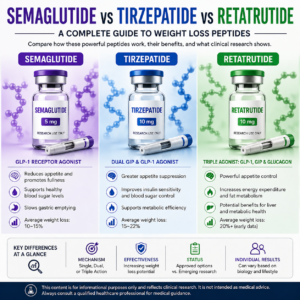
| Feature | Semaglutide | Tirzepatide | Retatrutide |
|---|---|---|---|
| Mechanism | GLP-1 | GLP-1 + GIP | GLP-1 + GIP + Glucagon |
| Weight Loss | ~10–15% | ~15–22% | 20%+ (early data) |
| Status | Approved | Approved | Investigational |
| Complexity | Moderate | Higher | Advanced |
Which Peptide Performs Best?
The answer depends on what you’re measuring.
- Appetite control: strong across all three
- Metabolic impact: increases from semaglutide → tirzepatide → retatrutide
- Weight loss potential: highest in newer multi-agonist compounds
However:
- Individual response varies
- Tolerability plays a major role
- Dose escalation affects outcomes significantly
What Real-World Use Looks Like
In clinical practice and research settings:
- Effects build over weeks to months
- Results improve with consistent use
- Lifestyle factors still play an important role
These are not instant solutions—but rather tools that influence long-term metabolic regulation.
A Smarter Way to Compare These Peptides
Instead of asking “which is best,” it’s often more useful to think in terms of progression:
- Semaglutide → established GLP-1 baseline
- Tirzepatide → enhanced dual-pathway approach
- Retatrutide → next-generation metabolic targeting
👉 Browse all compounds: View research peptide catalogue
Final Thoughts
Semaglutide, tirzepatide, and retatrutide represent a clear evolution in metabolic therapies.
Each step introduces:
- more complex mechanisms
- stronger potential effects
- and new considerations around tolerability and long-term use
As research continues, these compounds are shaping the future of weight loss treatments and metabolic health strategies.
Continue Exploring
If you’re looking to go deeper:
- Semaglutide overview
- Tirzepatide details
- Retatrutide research
This content is for informational purposes only and based on published clinical research. It is not intended as medical advice.