
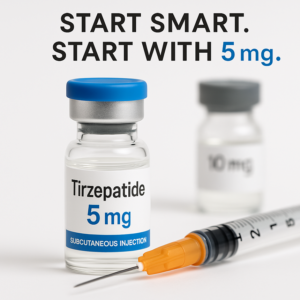
Tirzepatide Vial Sizes: Understanding 5 mg and 10 mg in Research Contexts
Interest in tirzepatide has grown rapidly across clinical and scientific communities. Alongside this, questions often arise about the practical differences between lower- and higher-strength vials, particularly 5 mg and 10 mg formats.
This article explores how different vial sizes are typically discussed in research, clinical development, and observational study settings, and why smaller quantities are commonly used during early stages of investigation.
This content is provided for educational and informational purposes only and does not constitute medical or dosing advice.
What Is Tirzepatide?
Tirzepatide is a synthetic peptide investigated for its activity at both GIP and GLP-1 receptors. In scientific literature, it is studied for its role in metabolic signalling pathways related to insulin response, appetite regulation, and energy balance.
It was initially developed for type 2 diabetes research and has since been evaluated in a wide range of controlled trials and real-world observational studies examining metabolic outcomes.
Why Different Vial Sizes Exist
In laboratory and clinical environments, multiple vial strengths are produced to support flexibility, precision, and staged evaluation. Smaller vial formats are commonly used during:
-
Early-phase trials
-
Dose-finding studies
-
Tolerability and safety assessments
-
Stepwise protocol designs
Larger vial formats are more frequently associated with later-stage or continuation protocols, where parameters are already well established.
5 mg vs 10 mg Vials: Conceptual Differences
5 mg Vials
Lower-quantity vials are often selected when:
-
Initiating structured research protocols
-
Conducting incremental evaluation
-
Reducing material waste during early stages
-
Supporting precision handling in laboratory environments
They are commonly referenced in contexts where careful control and gradual adjustment are prioritised.
10 mg Vials
Higher-quantity vials are typically referenced in:
-
Extended research timelines
-
Later-phase investigations
-
Situations where handling efficiency is required
-
Ongoing comparative or longitudinal studies
They are not inherently “better” or “stronger” — they simply reflect different logistical and protocol needs.
Why Smaller Quantities Are Often Used First
Across clinical research more broadly, it is standard practice to begin with conservative quantities before progressing further. This approach supports:
-
Improved data consistency
-
Better monitoring of tolerability markers
-
Reduced variability in early observations
-
Alignment with ethical research frameworks
This principle is not unique to tirzepatide and applies across many investigational compounds.
Research-Focused Supply Considerations
When sourcing peptide materials for scientific purposes, laboratories and research teams typically consider:
-
Purity and batch traceability
-
Storage stability
-
Flexibility for protocol design
-
Compliance with research-only use standards
Vial size selection is therefore a practical decision, not a performance claim.
A Note on Interpretation
Discussion of vial formats should not be confused with recommendations for personal use. Any references to quantities or formats within scientific literature are context-specific and interpreted within controlled environments under professional oversight.
Final Thoughts
Understanding why different tirzepatide vial sizes exist helps clarify how research and development processes are structured. Smaller formats are commonly used during early or exploratory phases, while larger formats may support longer-term or later-stage work.
As with all investigational materials, interpretation should remain grounded in published research, regulatory frameworks, and professional guidance.
Good
Very good