
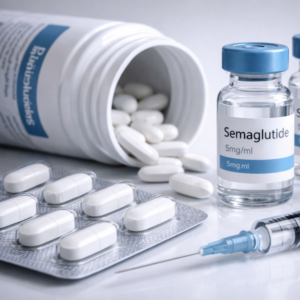
Semaglutide is a glucagon-like peptide-1 (GLP-1) receptor agonist that has been widely studied in relation to glucose regulation and appetite-related biological pathways. While it is most commonly associated with injectable formulations, an oral (tablet) version has also been developed and approved for specific clinical indications.
Although both formats contain the same active compound, the method of delivery introduces important scientific and pharmacokinetic differences. This article explores how oral and injectable semaglutide compare from a formulation and research perspective, rather than from a treatment or consumer standpoint.
1. Formulation and Delivery Method
Injectable Semaglutide
Injectable semaglutide is administered subcutaneously, allowing the peptide to enter systemic circulation without passing through the digestive system. This route avoids gastrointestinal degradation and is associated with relatively predictable absorption patterns.
From a research perspective, injectable formulations are often used when:
-
Controlled and consistent systemic exposure is required
-
Long-acting pharmacokinetics are being examined
-
Dose–response relationships need precise modelling
Oral (Tablet) Semaglutide
Oral semaglutide presents a distinct formulation challenge, as peptide compounds are typically broken down by stomach acid and digestive enzymes. To address this, oral formulations are developed alongside absorption-enhancing technologies designed to support uptake through the gastrointestinal lining.
This makes oral semaglutide a useful case study in areas such as:
-
Peptide stabilisation strategies
-
Gastrointestinal absorption mechanisms
-
Oral delivery of large-molecule compounds
2. Bioavailability and Absorption
One of the most notable scientific differences between oral and injectable semaglutide lies in bioavailability.
-
Injectable semaglutide is associated with higher and more predictable systemic exposure.
-
Oral semaglutide has lower absolute bioavailability, with absorption influenced by factors such as timing of administration, stomach contents, and individual gastrointestinal physiology.
These differences are of particular interest in pharmacokinetic research, especially when examining:
-
Peak plasma concentrations
-
Time to steady state
-
Inter-individual variability
3. Dosing Considerations in Research Contexts
Due to differences in absorption efficiency:
-
Oral formulations are typically studied at higher nominal doses to achieve comparable systemic exposure.
-
Injectable formulations allow for lower administered doses with more consistent plasma levels.
For researchers, this distinction is relevant when designing studies involving:
-
Dose scaling
-
Exposure–response modelling
-
Comparative pharmacology
4. Stability and Handling Considerations
Injectable semaglutide is commonly supplied as a solution or as a reconstituted formulation, requiring controlled storage and handling conditions.
Oral semaglutide, by contrast, must maintain:
-
Solid-state stability
-
Protection from moisture and heat
-
Formulation integrity over time
These differences make each format relevant for different areas of formulation science and stability research.
5. Why This Comparison Matters
Although oral and injectable semaglutide involve the same active molecule, they are not interchangeable from a scientific or formulation standpoint. Each approach offers insight into different challenges within peptide drug development, including:
-
Delivery system design
-
Absorption enhancement
-
Long-acting versus daily exposure models
Understanding these distinctions is important when interpreting study outcomes or comparing data across trials that use different formulations.
Summary
Oral and injectable semaglutide represent two distinct strategies for delivering the same peptide compound. Injectable formulations are associated with predictable systemic exposure, while oral formulations highlight advances in peptide delivery and absorption technology.
From a research and development perspective, both formats contribute valuable insights into GLP-1–based compounds and the broader field of peptide therapeutics.
Limitations of Current Evidence
While both oral and injectable semaglutide have been widely studied, several limitations in the current evidence base should be acknowledged.
Direct head-to-head comparisons between the two formulations remain limited, with many studies evaluating each format separately under differing protocols, populations, and dosing schedules. This makes direct comparison more complex.
Absorption variability, particularly with oral formulations, introduces additional uncertainty, as factors such as food intake, gastric emptying, and individual physiology can influence systemic exposure.
Much of the existing data also focuses on short- to medium-term outcomes, with fewer long-duration studies examining extended exposure, long-term formulation stability, or comparative pharmacodynamics over time.
As peptide delivery technologies continue to evolve, conclusions drawn from current formulations may require reassessment as new data emerges.
Regulatory & Use Notice
This content is provided for informational and scientific discussion purposes only. Semaglutide is a prescription-only medicine. No product, formulation, or route of administration is being promoted or recommended. References to dosing, delivery methods, or mechanisms relate to published research and regulatory-approved data and do not constitute medical advice.